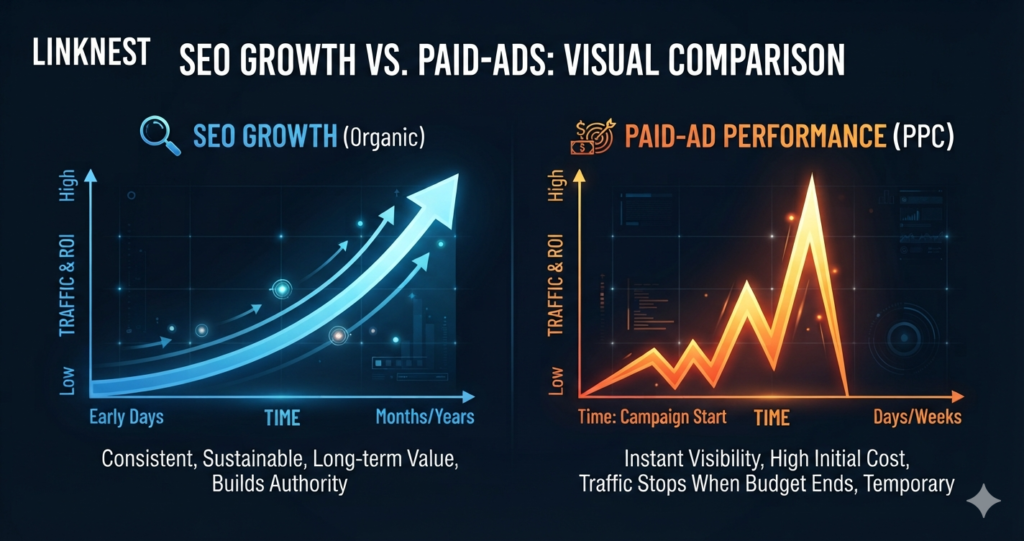
SEO builds lasting organic traffic, while ads stop the moment you stop paying. See a full cost, trust, and ROI comparison here.
Why SEO Is Better Than Advertising
Every business owner eventually faces the same budget question. Should you invest in search engine optimization, or should you pour money into paid advertising? Both promise visibility, and both promise traffic. However, only one of them keeps working long after you stop paying for it.
In this guide, we’ll break down how SEO and advertising actually compare. We’ll look at cost, longevity, trust, and return on investment, so you can decide where your marketing budget is best spent. For a deeper look at ranking factors, you can also check out this guide from Google’s own Search Central documentation.
What Is SEO?
SEO, in short, is the process of optimizing your website so it ranks higher in organic, unpaid search results. This includes your content, your site structure, and your backlink profile. Because of this, when someone searches for a product or service like yours, strong SEO helps your site show up naturally, without you paying for that click.
If you’d like a refresher on the fundamentals, our own guide to link building basics walks through how backlinks influence rankings.
What Is Advertising?
Advertising, on the other hand, means paid channels such as Google Ads, Facebook Ads, Instagram promotions, and similar pay-per-click models. In these models, you bid for placement. As a result, the moment you stop paying, your visibility disappears.
SEO vs. Advertising: A Side-by-Side Comparison
| Factor | SEO | Advertising |
| Cost over time | Upfront investment, low long-term cost | Ongoing cost for every click or impression |
| Longevity | Rankings can last months or years | Traffic stops the moment you stop paying |
| Trust factor | Organic results feel earned and credible | Users often skip or ignore “sponsored” tags |
| Traffic quality | Attracts users actively searching for your offer | Can attract clicks from uninterested users |
| Time to results | Slower (weeks to months) | Immediate |
| Scalability | Compounds over time as authority grows | Scales only as fast as your budget allows |
1. SEO Delivers Long-Term Value
This is, without question, the biggest reason businesses lean toward SEO. For example, a well-optimized article can keep ranking, and keep bringing in visitors, for years after it was published. Advertising, in contrast, is more like a rental. The instant your budget runs dry, so does your traffic.
Because of this, think of SEO as building an asset. Every backlink, every optimized page, and every piece of quality content adds to a foundation that keeps paying off. Advertising, meanwhile, is more like renting a billboard: visible while you’re paying, invisible the moment you stop.
2. Organic Results Build More Trust
Interestingly, studies on user behavior consistently show that people trust organic search results more than paid ads. In fact, many users actively scroll past the “Sponsored” label to find natural listings instead. This is because ranking organically signals that your business earned its position rather than bought it.
As a result, that credibility often translates into higher click-through rates and better conversion rates once visitors land on your site.
3. Lower Cost Per Acquisition Over Time
Although paid advertising can deliver fast results, the cost per click keeps adding up. In competitive industries, that cost only rises further. SEO, by comparison, requires upfront investment in content and backlinks, but once you rank, each additional visitor essentially costs you nothing extra.
Therefore, for businesses playing the long game, SEO tends to be one of the most cost-efficient channels available.
4. SEO Targets Intent, Not Just Attention
Unlike SEO, paid ads often interrupt people. They show up in a feed or between content, regardless of whether the viewer wants to buy. SEO, however, works differently: it puts your site in front of people who are already searching for what you offer. Consequently, that intent-driven traffic tends to convert better, since the visitor came looking for a solution rather than scrolling past a distraction.
Where Advertising Still Has an Edge
To be fair, advertising is not obsolete. In fact, it has real strengths that SEO simply can’t match:
- Speed: ads can generate traffic and leads within hours of launching a campaign.
- Precise targeting: platforms like Meta and Google Ads let you target by demographics, interests, and behavior.
- Predictable scaling: if you want more traffic tomorrow, you can simply increase the ad budget.
- New business visibility: a brand-new site with no authority yet may need paid traffic for initial visibility.
The Smartest Approach: Use Both, Strategically
Ultimately, the most successful digital strategies rarely rely on just one channel. Instead, a common and effective approach looks like this:
1. First, use paid advertising for time-sensitive campaigns or launches, to generate immediate traffic and data.
2. Meanwhile, invest in SEO to build a durable, long-term traffic source that doesn’t depend on constant spending.
3. Finally, once your rankings mature, gradually shift budget away from ads and let SEO carry more of the load.
Final Verdict
If your goal is sustainable growth with strong ROI, SEO is, overall, the smarter long-term play. It builds authority, earns trust, and keeps generating traffic without ongoing spend. That said, advertising still has its place, especially for quick wins and precise targeting. As a long-term growth engine, though, SEO consistently outperforms it.
For businesses ready to invest in that long-term foundation, quality backlinks and optimized content are the best place to start. After all, that groundwork is what turns a website into a lasting traffic asset, rather than one that disappears the moment the ad budget runs out.
Looking to strengthen your site’s SEO foundation with quality backlinks? Explore our listings on Digital Linknest and start building lasting organic visibility today.