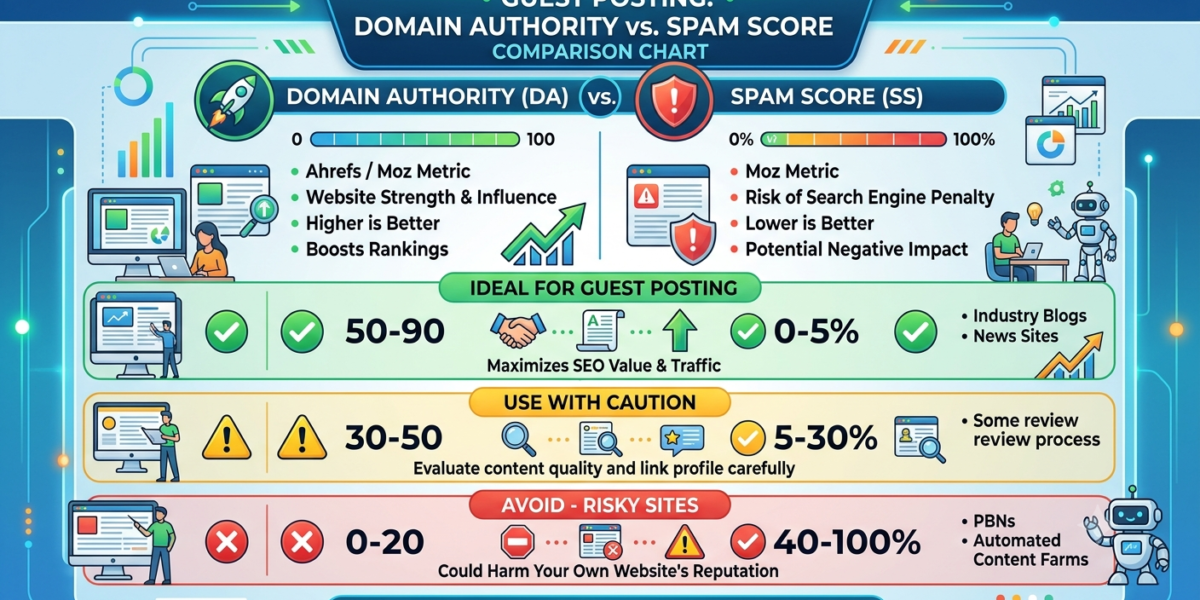
Every guest posting guide tells you to “check the DA” and “check the Spam Score” — as if the two metrics always agree. They don’t. We pulled both metrics across 50 real guest post sites and found several cases where a high DA site carried a dangerously high Spam Score, and low-DA sites came back completely clean. Here’s what actually predicts risk, based on the data — not assumption authority vs spam score
What DA and Spam Score Actually Measure (and Why They Can Disagree)
Domain Authority (DA) predicts how likely a site is to rank in search results, based largely on the volume and strength of its backlink profile. It answers: “How much link equity does this site have?”
authority vs spam score
Spam Score estimates how closely a site’s profile resembles domains Google has penalized or deindexed in the past, based on Moz’s own Spam Score methodology. It answers a completely different question: “Does this site show warning signs of manipulation?”
These are independent measurements. A site can accumulate a large, authoritative-looking backlink profile (high DA) while also showing spam-adjacent patterns (high Spam Score) — link volume and link safety aren’t the same thing. This is the gap most “check the DA before guest posting” advice skips entirely.
The Data: 50 Real Guest Post Sites, DA and Spam Score Side by Side
We ran a full DA/PA/Spam Score check across our guest post inventory. Domain Authority ranged from 1 to 95 (average 54.9). Here’s where the two metrics visibly disagreed:
| Site | DA | Spam Score | What it tells you |
| msn.com | 95 | 32 | High authority, high risk — DA alone would hide this |
| 1883magazine.com | 54 | 17 | Mid authority, elevated risk |
| goodmanproject.com | 11 | 72 | Low authority AND high risk — avoid entirely |
| ipsnews.net | 83 | 1 | High authority, clean profile — the actual safe bet |
The pattern: DA and Spam Score don’t move together. A site can rank in the top percentile for authority and still carry serious risk markers. Relying on DA alone to shortlist guest post sites would have let the two riskiest sites in this batch straight through.
So Which One Should You Trust More?
Neither one, in isolation — but if forced to choose a single filter first, Spam Score is the safer starting gate.
Here’s the reasoning: a low-DA, clean site is simply a smaller opportunity — it passes less authority, but it won’t actively hurt you. A high-DA, high-Spam-Score site is a bigger risk: if Google later re-evaluates that domain’s link neighborhood, links pointing from it can lose value or, in worse cases, become a liability if the domain gets penalized. Filtering out risk protects your existing link profile. Filtering for authority only grows it. Protecting comes first.
A Simple Two-Step Filter (Based on This Data)
- Eliminate anything with Spam Score above 10–15, regardless of DA. No exceptions — a high DA does not offset this.
- Within what’s left, rank by DA to prioritize which sites are worth pursuing first.
This is the same spam-first sorting logic covered in more depth in our guide on how to screen guest post sites in 10 minutes — this article focuses specifically on why that order matters, not just how to do it.
Applied to this batch: msn.com and 1883magazine.com would be filtered out at step 1, despite their strong DA. ipsnews.net, techbullion.com, and similar DA 70–85 / Spam Score under 5 sites would rise to the top — the actual safest, highest-value placements in the set.
Frequently Asked Questions
Is Domain Authority a Google ranking factor?
No. DA is a third-party metric created by Moz to estimate ranking potential. Google doesn’t use it directly, but it correlates reasonably well with overall site authority.
What Spam Score is considered safe for guest posting?
Generally, under 10 is considered low-risk, 10–30 is a caution zone worth a manual review, and above 30 is high-risk regardless of DA.
Can a site have high DA and be completely safe?
Yes — ipsnews.net in this dataset is a clean example: DA 83 with a Spam Score of just 1. High DA and low risk aren’t mutually exclusive; they’re just not guaranteed to go together, which is exactly why both metrics need checking.
Should I ever use a high-Spam-Score site if the DA is high enough?
Generally no. A backlinks downside risk (association with a flagged domain) usually outweighs the upside of raw authority, especially since Spam Score patterns can worsen over time as a domain’s link neighborhood degrades further — a pattern Google’s own spam policies explicitly warn against building links toward or from.
Want to skip the manual filtering? Our verified website marketplace is pre-screened for both DA and Spam Score, so every listed site has already passed this two-step check.
Analysis based on a live DA/PA/Spam Score check across 50 sites in our guest post inventory, August 2026.